


Invited talk on Spectropolarimetry of (exo)planetary atmospheres
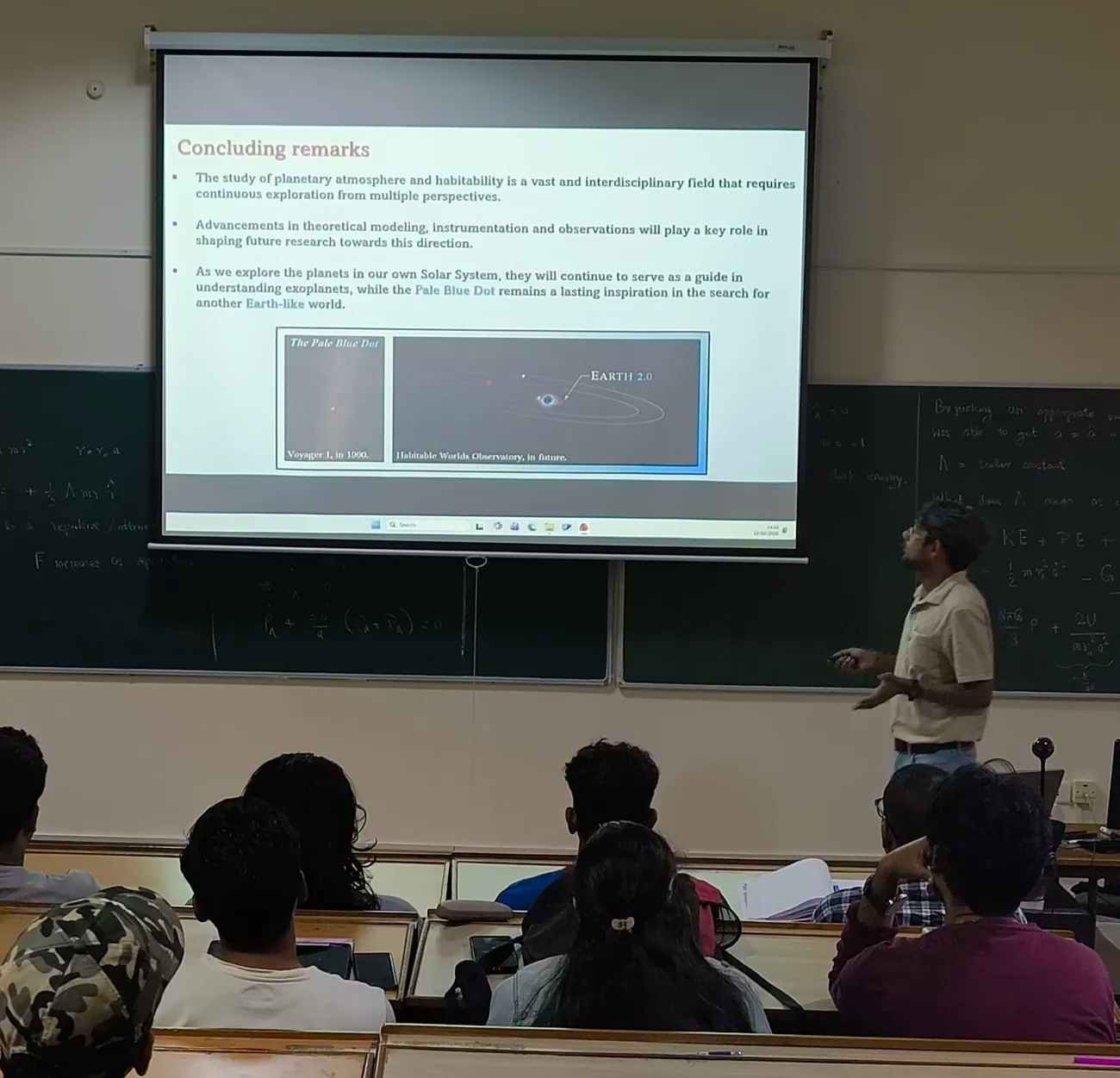
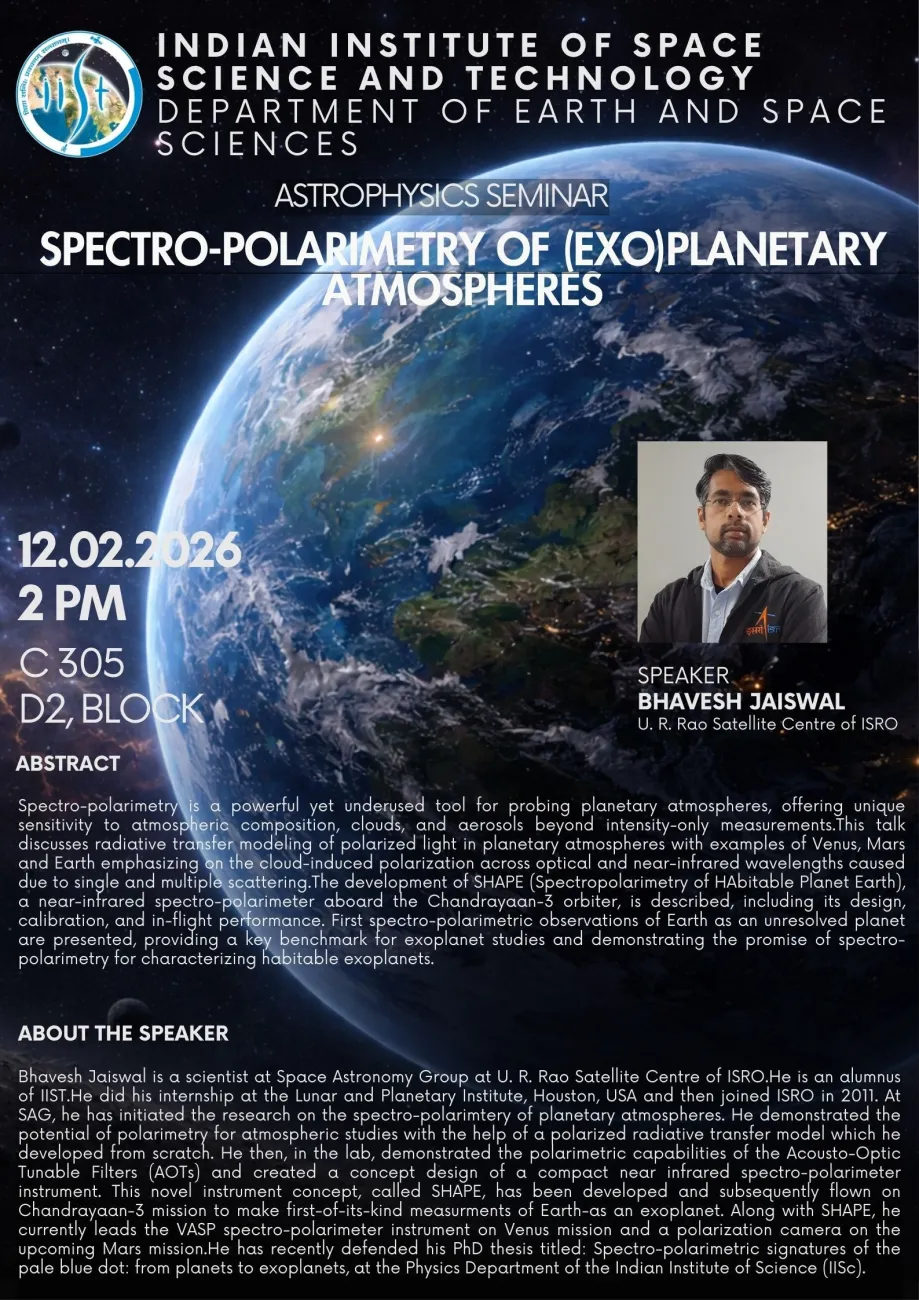
An astronomy invited talk by Bhavesh Jaiswal (U. R. Rao Satellite Center, ISRO) exploring spectro-polarimetric signatures of (exo)planetary atmospheres, combining theoretical modeling, instrumental development, and observational validation.
Abstract
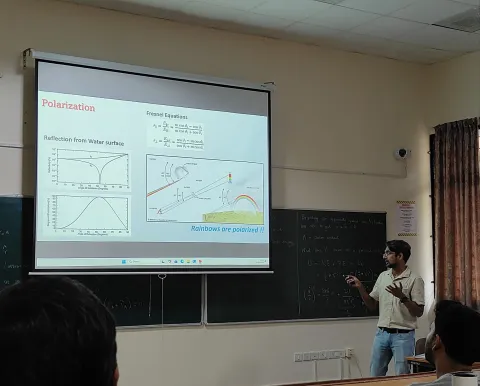
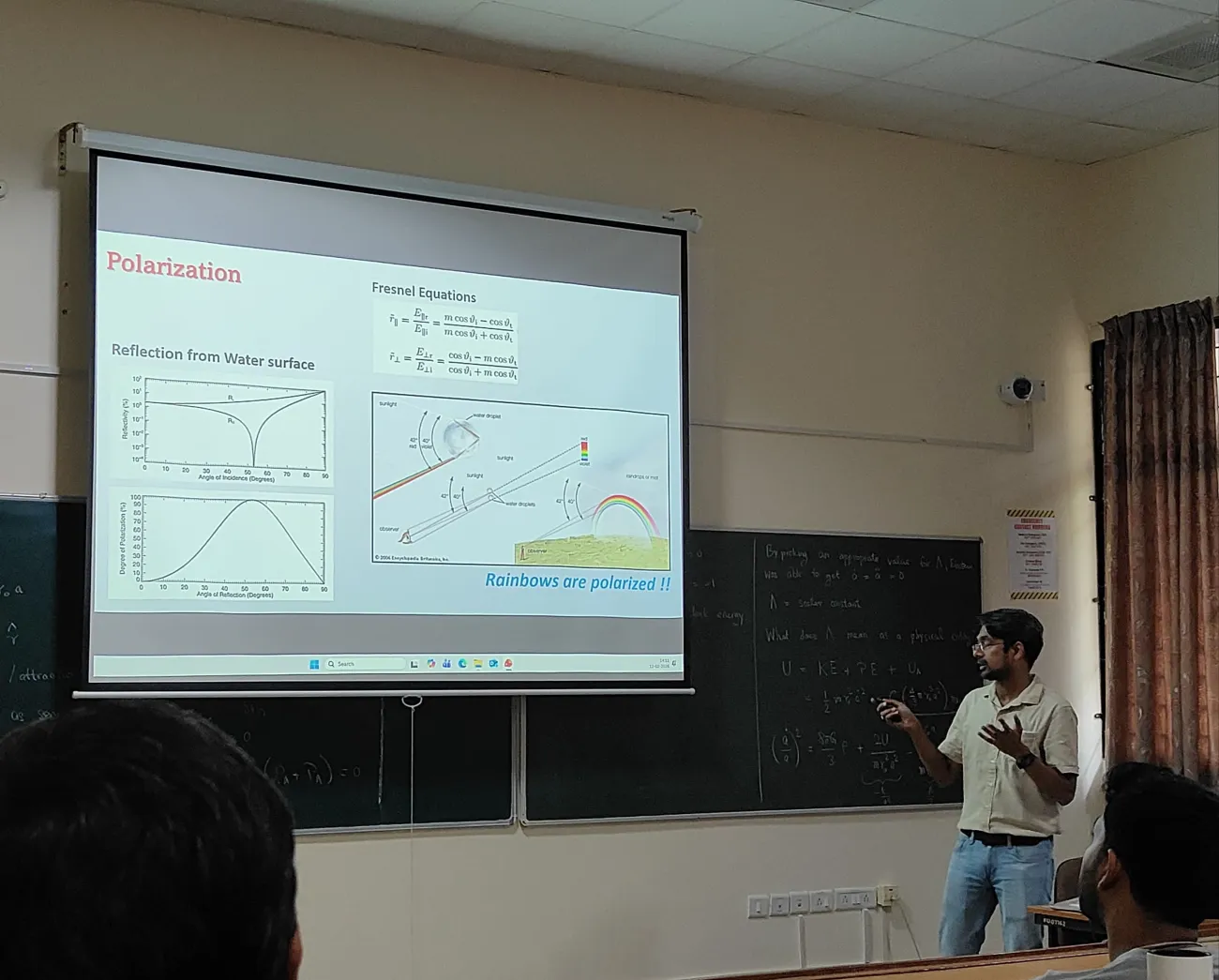
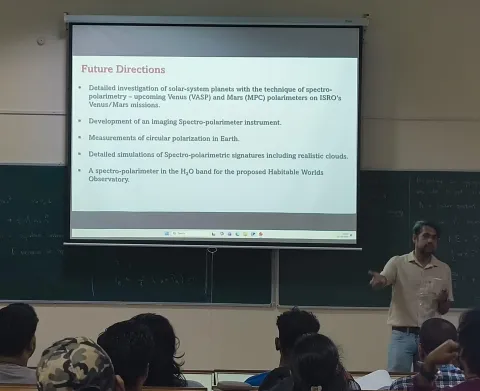
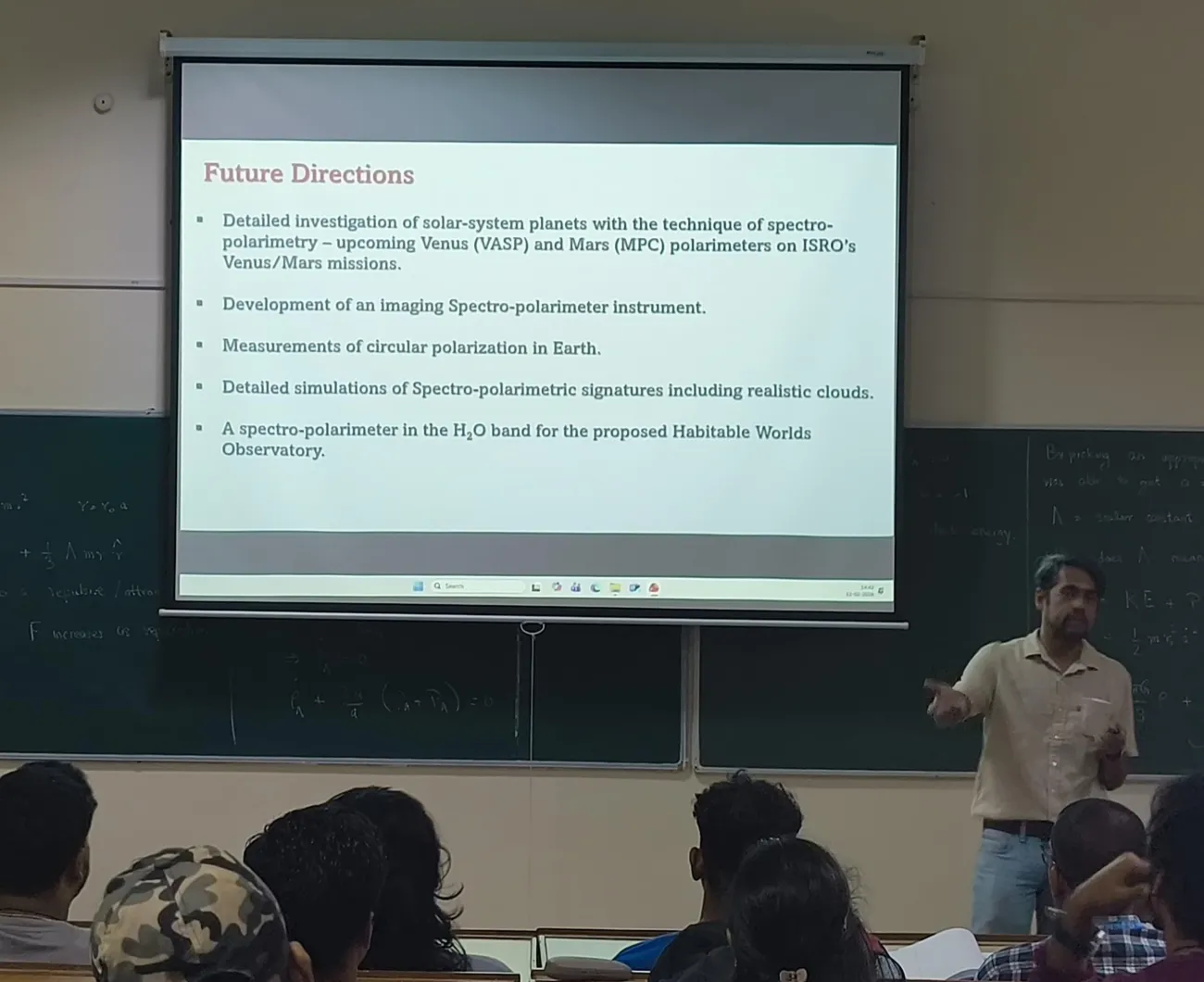
Spectro-polarimetry provides a powerful and largely untapped diagnostic of planetary atmospheres, offering sensitivity to atmospheric composition, cloud and aerosol properties that are difficult to access with intensity-only measurements. This talk will discuss radiative transfer modeling of polarized light in planetary atmospheres with examples of Venus, Mars, and Earth. The cloud-induced polarization across optical and near-infrared wavelengths caused due to single and multiple scattering is discussed. These models are used to predict disk-integrated spectro-polarimetric signals for Earth-like planets under a range of atmospheric and viewing geometries, and to identify observables that are robust tracers of atmospheric structure and planetary surface. The development of SHAPE (Spectropolarimetry of HAbitable Planet Earth), a near-infrared spectro-polarimeter aboard the Chandrayaan-3 orbiter, is presented. Designed for high polarimetric sensitivity and spectral resolution, SHAPE observes Earth as an unresolved exoplanet analog. Instrument design, calibration strategies, and in-flight performance are discussed, with emphasis on mitigating instrumental polarization and systematic effects. The first spectro-polarimetric observations of Earth as an unresolved planet are also discussed, providing a critical benchmark for exoplanet studies and demonstrating the potential of spectro-polarimetry for future characterization of habitable exoplanets.
Bhavesh Jaiswal is a scientist at the Space Astronomy Group at U. R. Rao Satellite Centre of ISRO. He graduated from the first batch of IIST in 2011 with a degree in Physical Sciences. He completed his internship at the Lunar and Planetary Institute, Houston, USA, and joined ISRO in 2011. At SAG, he initiated research on spectro-polarimetry of planetary atmospheres. He demonstrated the potential of polarimetry for atmospheric studies using a polarized radiative transfer model developed from scratch. He also demonstrated the polarimetric capabilities of Acousto-Optic Tunable Filters (AOTFs) and developed a concept design of a compact near-infrared spectro-polarimeter instrument. This novel instrument concept, called SHAPE, was developed and flown on the Chandrayaan-3 mission to make first-of-its-kind measurements of Earth as an exoplanet. Along with SHAPE, he currently leads the VASP spectro-polarimeter instrument on the Venus mission and a polarization camera on the upcoming Mars mission. He has recently defended his PhD thesis titled “Spectro-polarimetric signatures of the pale blue dot: from planets to exoplanets” at the Physics Department of the Indian Institute of Science (IISc).
Event Details
-
Mode:In-Person