
Kerala on Mars
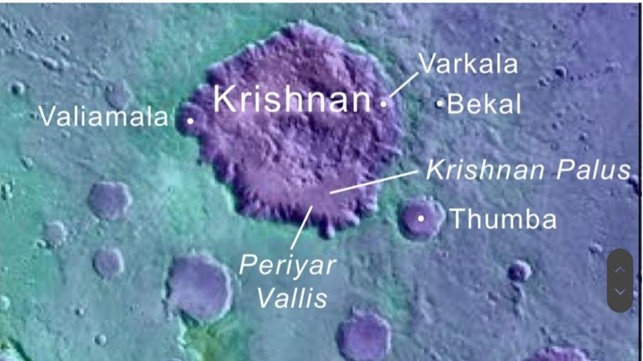
The International Astronomical Union (IAU) has approved the name of M. S. Krishnan, a pioneering Indian geologist, for a 3.5-billion-year-old crater on Mars. The crater lies in a region where evidence of ancient glaciation has been scientifically established. The naming proposal was jointly submitted by Prof. Rajesh V. J. (Department of Earth and Space Sciences, Indian Institute of Space Science and Technology, IIST) and Dr. Asif Iqbal Kakkassery (who was a research scholar under the guidance of Dr. Rajesh V.J. at IIST and currently working as Assistant Professor of Geology at Government College, Kasaragod). Their research at IIST on an unnamed crater in the Xanthe Terra region of Mars identified signs of ancient glacial processes and fluvial activity. These findings were published in the peer-reviewed journal Meteoritics & Planetary Science (https://onlinelibrary.wiley.com/doi/10.1111/maps.70012). As part of their work, the team proposed several Kerala-based names for nearby Martian landforms. Although many were initially rejected due to pronunciation and compliance issues related to IAU naming conventions, persistent documentation and review ultimately resulted in the approval of several names, including Valiamala, the home of IIST. the IAU communicated the final list of approved Martian feature names: Krishnan Crater, Valiamala Crater, Thumba Crater, Bekal Crater, Varkala Crater, Periyar Vallis, Krishnan Palus. The approval highlights the global impact of planetary research emerging from IIST. IIST and Kerala now have their imprint on the Martian landscapes. According to IAU guidelines, large, significant Martian craters may be named after deceased scientists who have made foundational contributions to planetary science. Smaller craters may be named after towns or villages with populations under 100,000, provided the names are easy to pronounce and have historical or cultural relevance. Following the naming of Krishnan Crater, the Working Group for Planetary System Nomenclature (WGPSN) has also approved four nearby small craters: Valiamala, Thumba, Varkala, and Bekal. This international recognition places IIST’s planetary research firmly on the global map, reflecting the expanding contributions of Indian scientists to Mars exploration and planetary geosciences.