


Catching Galaxies in the Act of Feeding: A River of Pristine Gas Flowing into a Distant Galaxy Pair
How do galaxies — the vast cities of stars that light up our Universe — keep forming new stars for billions of years? They need fuel. Just as a fire dies without fresh wood, a galaxy’s star formation would eventually sputter out unless fresh gas is continuously supplied from outside. Where does this fuel come from, and can we actually catch it in the act of flowing in? A team of astronomers from IIST, in collaboration with researchers from IUCAA (Pune), Penn State University (USA), and the University of Milano-Bicocca (Italy), has now found a striking answer. In their new paper, titled “A Partial Lyman Limit Absorber in the Halo of a Galaxy Pair: A Possible Signature of Gas Inflow,” published in The Astrophysical Journal, the team has discovered a cloud of nearly pristine gas sitting at the doorstep of two galaxies — likely a stream of cosmic fuel caught mid-delivery.
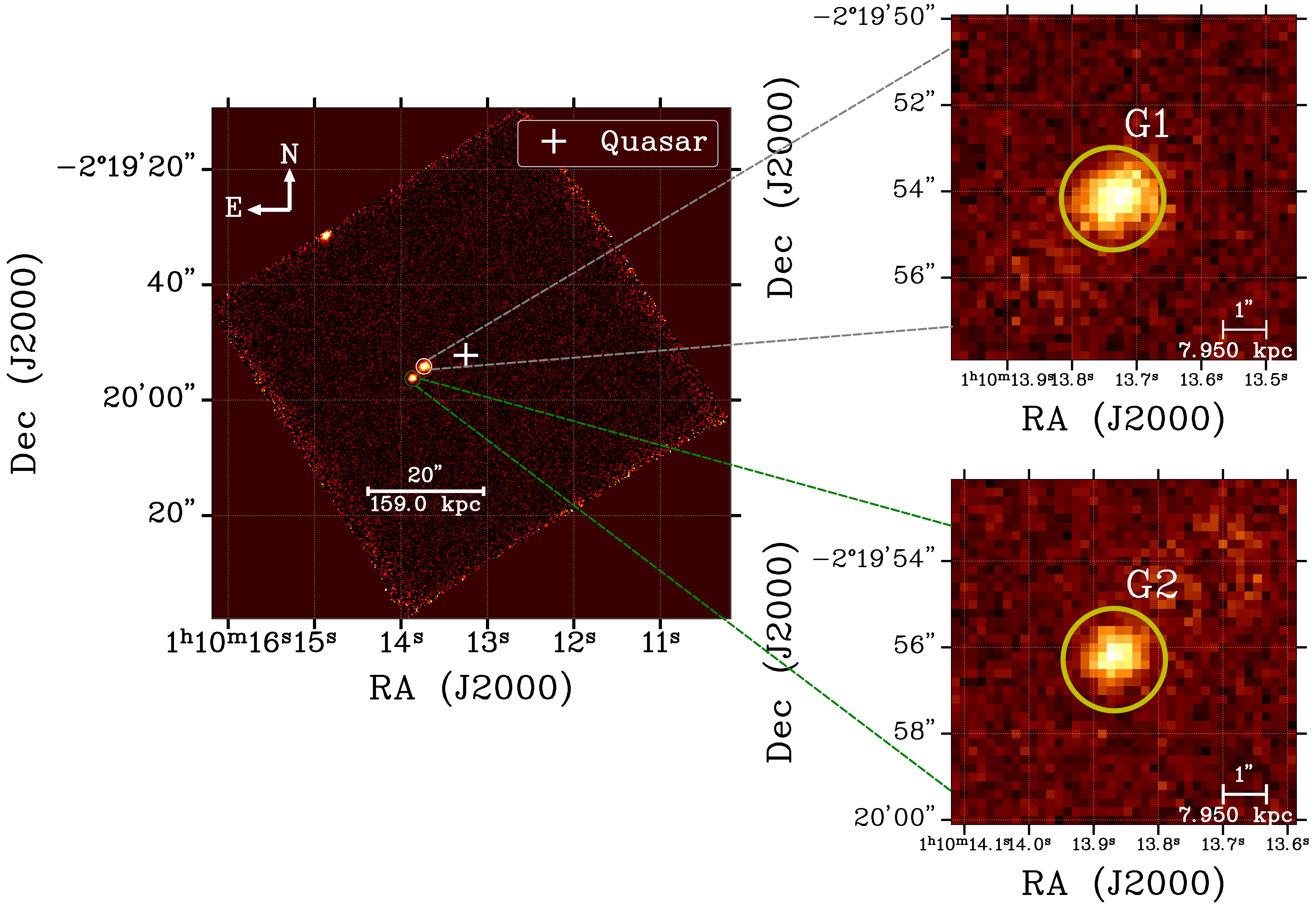
VLT/MUSE narrowband image of the galaxy pair field showing galaxies G1 and G2 alongside the background quasar sightline, with zoomed insets revealing the morphology of each galaxy
The trick to detecting this invisible gas lies in a clever cosmic alignment. Imagine a bright flashlight placed behind a cloud of fog — the fog leaves its shadow on the beam of light. Similarly, when light from a very bright, distant object called a quasar passes through gas surrounding a foreground galaxy, the gas absorbs specific colours (wavelengths) of that light, leaving a characteristic fingerprint. By reading this fingerprint in exquisite detail using the Hubble Space Telescope’s ultraviolet spectrograph (COS) and ESO’s Very Large Telescope equipped with the MUSE integral field spectrograph in Chile, the team pieced together a remarkably complete picture: a cloud of gas at a lookback time of roughly 7 billion years (redshift z ≈ 0.876), hovering about 120 kiloparsecs — nearly 400,000 light-years — from each of the two galaxies.

Absorption line profiles of hydrogen (Lyman series) and metal ions (O III, O IV, O V, S IV, S V) detected in the quasar spectrum, with Voigt profile fits shown in blue. These spectral fingerprints reveal the chemical composition, temperature, and kinematics of the gas cloud.
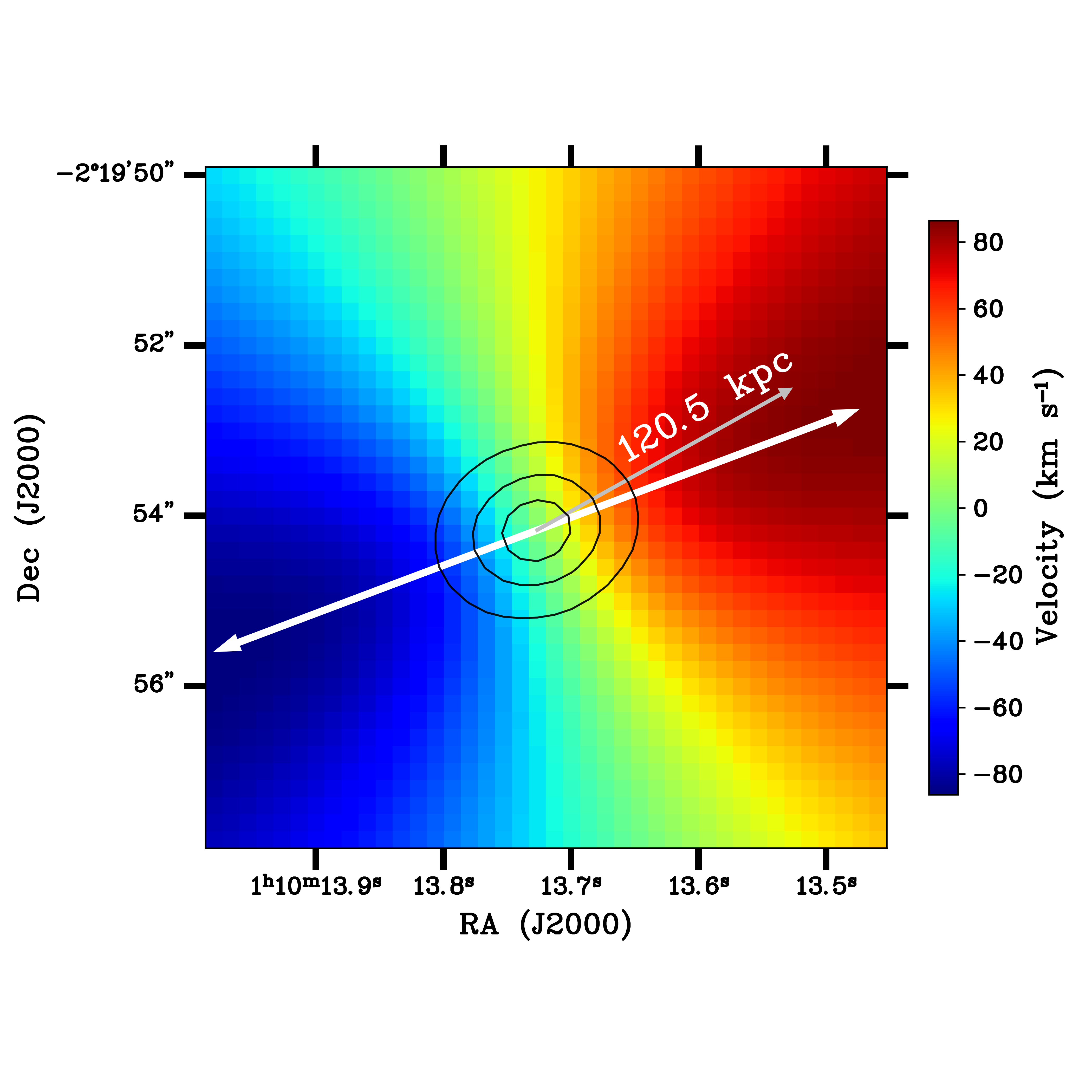
What makes this gas cloud special? Three things stand out. First, its chemistry: the gas contains metals (elements heavier than hydrogen and helium) at only about one-tenth of the Sun’s abundance — far less enriched than the gas typically expelled by supernovae and stellar winds inside galaxies. More tellingly, it shows a striking deficiency in nitrogen relative to oxygen. Since nitrogen is mainly produced by intermediate-mass stars that take hundreds of millions of years to evolve, this chemical pattern points to gas that is in a very early stage of enrichment — or has been diluted by near-pristine material flowing in from the intergalactic medium. Second, its geometry: the gas cloud lies along the projected major (long) axis of both galaxies. Theoretical simulations predict that fresh gas from the cosmic web preferentially funnels in along galaxy disks, while galactic winds tend to blow out perpendicular to the disk. The alignment observed here is exactly what one would expect for inflowing gas. Third, its temperature: photoionisation modelling shows the gas is far too cool to be part of the hot, shock-heated halo that surrounds massive galaxies — consistent with the theoretical picture of “cold-mode accretion,” where streams of gas from the cosmic web penetrate deep into galaxy halos without being heated, delivering fuel directly for star formation.
Velocity map of Galaxy G1 derived from GalPaK3D modelling of VLT/MUSE data. The colour gradient from blue to red shows the galaxy’s rotation. The white arrow points toward the background quasar sightline at a projected distance of 120.5 kpc, lying along the galaxy’s major axis — the preferred direction for gas inflow.
Velocity map of Galaxy G2, also showing an organised rotating disk. The quasar sightline again lies close to the major axis of this galaxy, strengthening the case that the detected gas is inflowing material rather than an outflow.
The study was led by Sumukha R. Bharadwaj, a PhD research scholar at IIST, working with Dr. Anand Narayanan (IIST), Dr. Sowgat Muzahid (IUCAA, Pune), Dr. Jane C. Charlton (Penn State University, USA), and Dr. Sebastiano Cantalupo (University of Milano-Bicocca, Italy). The results offer a rare, direct observational glimpse into a process that is fundamental to how galaxies evolve but is extraordinarily difficult to observe — the quiet, steady replenishment of a galaxy’s gas reservoir by near-pristine material from the cosmic web. In the grand narrative of the Universe, galaxies are not isolated islands adrift in empty space; they are living ecosystems, continually nourished by rivers of gas that flow along the invisible scaffolding of the cosmic web, sustaining the birth of new stars across cosmic time.